Almost every puff print failure we see in customer returns comes down to four or five root causes.
This is the troubleshooting checklist we walk our own QC team through, written for brand quality managers and print shop owners who need to stop a defect showing up in production.
How a puff print actually rises
A puff print is plastisol ink loaded with a thermally activated foaming agent. The foaming agent is a microcapsule. Below its trigger temperature it does nothing. Above the trigger (typically around 320 to 340 F / 160 to 170 C), the capsule wall softens and the gas inside expands. The ink, still soft, inflates around the gas. Then as the heat continues, the plastisol cures and locks the foamed structure in place.
Every failure mode below is a deviation from that sequence.
Defect 1: The print cracks after a few washes
What you see: hairline splits across the raised surface, usually after the first or second wash. The crack often follows the longest dimension of the print.
Root cause, in order of how often we see it:
- Heat press temperature too low. The plastisol never fully cured. The print foamed, but the matrix is still soft. Wash agitation breaks it.
- Dwell time too short. Same effect. The capsule expanded but the cure did not complete.
- Fabric stretch mismatch. A rigid puff was pressed onto a high-stretch knit (lycra, spandex blend). The fabric stretches in wash, the cured puff cannot follow, and it splits.
Fix:
- Verify your press temperature with an IR thermometer on the platen, not the controller readout. Controllers drift.
- Add 2 to 3 seconds of dwell and re-test.
- For stretchy fabrics, request a stretch puff formulation up front. Standard puff is built for low-stretch cotton and cotton blends.
Defect 2: The print is flat or barely raised
What you see: the print is on the garment, but the raise is half what the sample looked like, or there is no raise at all.
Root cause:
- Pressure too high. This is the most common cause we see. With puff, excessive pressure squeezes the gas out of the foam before it can set.
- Pre-press too aggressive. A long, hot pre-press cures the foaming agent before the actual transfer step. By the time the real press happens, there is nothing left to expand.
- Storage degradation. Puff transfers stored above 30 C / 86 F for weeks can pre-activate. Always store transfers cool and use within the shelf life on the packing list.
Fix:
- Run medium pressure, not heavy. The transfer release is the goal, not fabric compression.
- Keep pre-press to 2 to 3 seconds at lower temperature. Just dry the garment, do not cure it.
- Store stock transfers in a climate controlled area.
Defect 3: Orange peel surface
What you see: the print rose, but the surface looks bumpy, uneven, almost like a citrus rind.
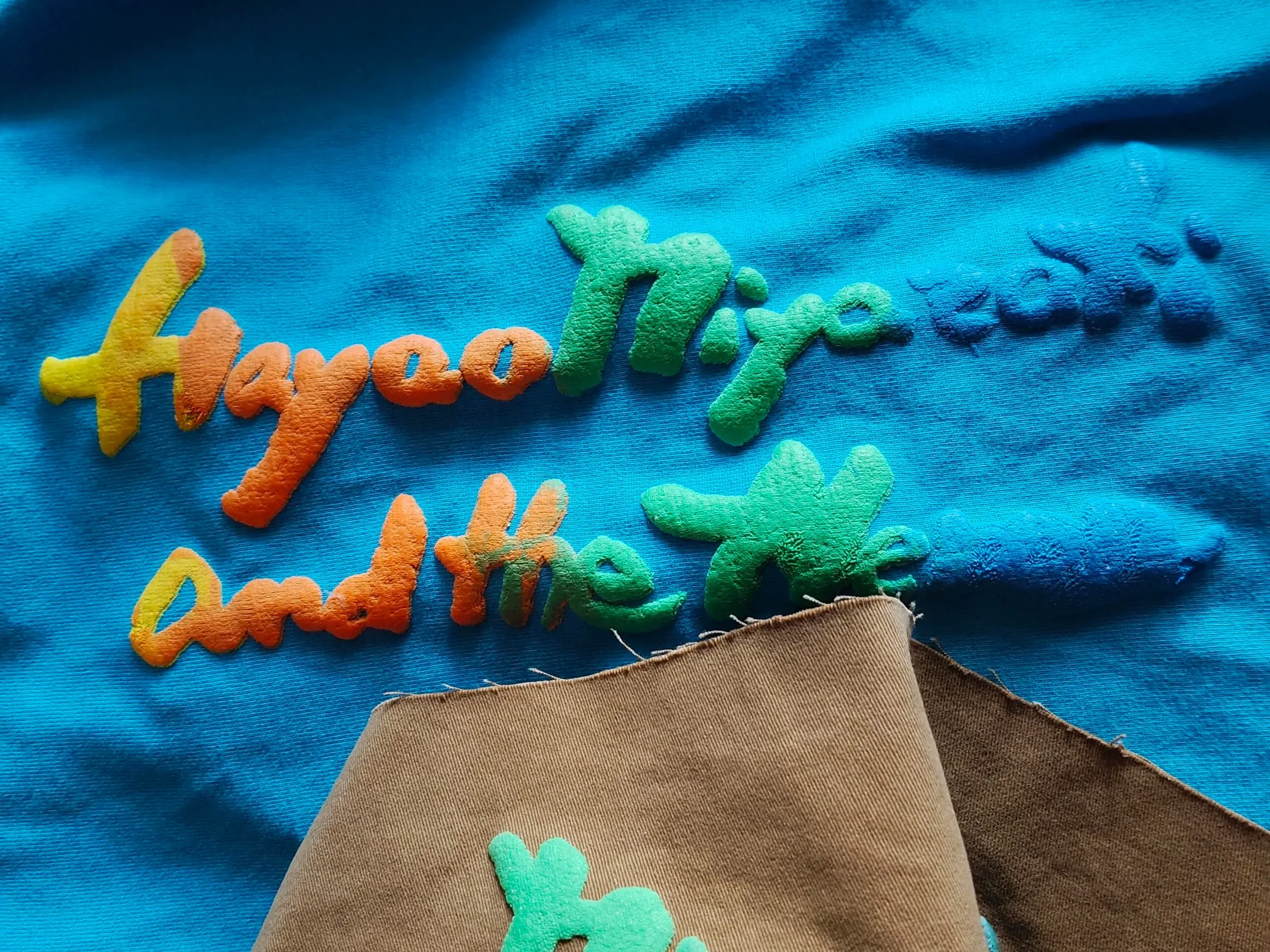
Root cause:
- Temperature too high or dwell too long. The capsule walls ruptured instead of expanding cleanly. The escaped gas leaves pits.
- Stacking the press cycles. Pressing the same area twice often gives this look. The second press over-cooks the already foamed structure.
Fix:
- Drop temperature by 5 to 10 C and re-test before adjusting time.
- Press once. If the operator needs a second pass for adhesion, the original parameters are wrong.
Defect 4: The print lifts at the edges
What you see: corners or thin edges of the print peel up after wash, even though the body of the print is solid.
Root cause:
- Insufficient pressure at the edge. The platen surface is not perfectly flat (worn pad, garment seam under the print, button under the print).
- Garment surface treatment. Some performance fabrics are coated with silicone or PFC water repellents that the adhesive cannot bite into.
- Wrong adhesive for the fabric. Cotton-grade adhesive on polyester is a classic source of edge lift.
Fix:
- Replace platen pads regularly. Check for high spots before each shift.
- For coated fabrics, request a sample test before committing.
- Always tell us the exact fabric blend of the blank when ordering. We match the adhesive on our side.
The standard test before a bulk release
Whether you press in-house or buy transfers from us, do not approve a bulk production batch without these three tests on a finished sample:
- Wash 5 cycles cold, line dry, inspect. No cracks, no lift.
- Stretch test: pull the print area to its working stretch (more for activewear, less for hoodies). No edge lift, no surface fracture.
- Rub-fastness: 100 dry strokes with a clean white cloth. No pigment transfer, no surface scuff.
If a sample passes all three, the bulk will hold. If any test fails, fix the parameter before you press the rest.
Most puff print defects come down to a handful of press parameters. Lock the press temperature, the dwell, the pressure, and the storage, and the failure rate drops to a level you can specify in your supply agreement.
If you are seeing a defect on bulk you cannot diagnose, send us a sample plus the press settings you ran. We will reproduce the conditions on our floor and tell you what to change.