In the last 18 months, the share of brand decks landing on our factory floor asking for 3D puff instead of flat DTF or screen print has roughly doubled. The shift is driven by the streetwear cycle’s return to dimensional, touchable graphics after a decade of flat-printed photoreal.
What “3D puff” actually means on a garment
A 3D puff print is a heat-reactive ink that expands upward during pressing. On the press it goes on flat. As it hits the curing temperature, the foaming agent activates and the print lifts. We dial it from a subtle 0.5 mm embossed feel up to a chunky 2 to 3 mm raise for hero logos.
What buyers respond to is the hand. Run your thumb across a 3D puff chest hit and it reads as a real, made object.
Why the shift is happening now
1. The retro / Y2K design loop has caught up to the print floor
Every visual reference board we see for 2026 SS and FW collections is full of late 90s and early 2000s sportswear. Heavyweight hoodies, varsity letters, chunky college fonts, big chest blocks. All of that originally lived in puff or chenille. Brands that were copying the look in flat DTF in 2023 and 2024 are now going back to the original technique.
2. Touch sells in a screen-first world
Online product photos are saturated. Almost every drop looks like every other drop in a thumbnail. The thing that separates a 3D puff hoodie in a customer’s hand from the same graphic in flat print is the handfeel. Brands that sell through pop-ups, showrooms, and try-on photo content are paying for that difference on purpose.
3. Perceived value at a sensible cost
A heavy fleece hoodie with a 2 mm puff chest hit reads as premium without the cost or fabric distortion of embroidery on the same blank.
What apparel brands should brief us on before sampling
If you are moving a graphic from flat to 3D puff, the design needs a small adjustment. Use the checklist below before you send art:
- Letter and stroke weight: 3D puff loves bold. Anything thinner than about 2 mm of stroke width will lose definition once the ink expands.
- Density of detail: a busy halftone pattern will smear into a blob once the print rises. Simplify hatching and dot fields into solid shapes.
- Color count: each color is its own layer. Two to three colors keeps the print sharp and the cost reasonable. Above four colors, talk to us first.
- Placement on the garment: puff lifts away from the fabric, so it sits best on flat panels. Avoid spanning the print across heavy seams, hoods, and ribbed cuffs.
- Garment weight: heavier fleece (380 gsm and up) carries a chunky 2 mm puff better than a 180 gsm tee. Match the lift height to the blank.
Where puff is winning right now
The categories where we see the most 3D puff demand:
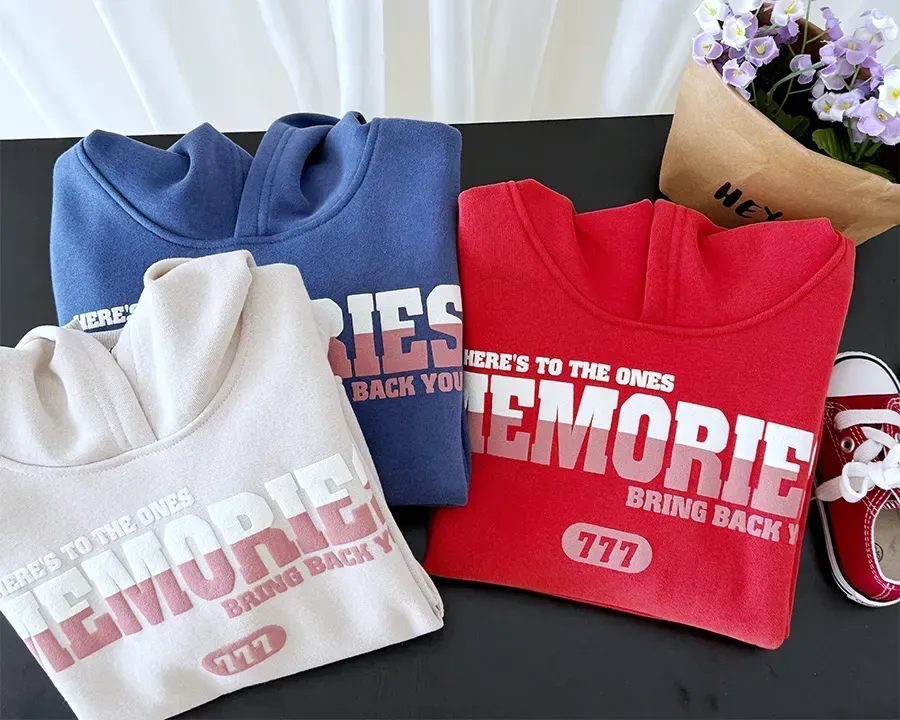
- Heavy fleece hoodies and crewnecks, especially 400 gsm and above
- Workwear inspired button-ups and chore jackets
- Cotton canvas tote bags and accessories with chunky logos
- Track pants and shorts with leg drop branding
- Headwear, especially structured 6 panel caps with raised front hits
How to test the look without committing to a full run
If you are unsure how a flat artwork will translate to 3D, the cheap path is a single sample test.
3D puff is not a replacement for flat printing. Photographic art and complex full-color graphics still belong on DTF or screen. For the heavyweight fleece and bold-mark category dominating 2026 streetwear, dimensional ink is the technique brands are specifying again.
If you would like to feel the lift in person, send us your artwork and the blank spec, we will press a sample so you can compare before bulk.